

“Wait so you study astrology? Can you read my horoscope? Do you know what it means when Mercury is in retrograde?” I hear questions like these at times when I tell people that I am a student of astronomy and astrophysics. And I don’t blame them. After all, astronomy and astrology do sound very similar. But even though they do, they are far from synonymous.
This widespread confusion between the two I have seen in my conversations and on the internet prompted me to write this blog. Here I hope to clarify the difference and explain why although astronomy/astrophysics is a well-established scientific discipline rooted in well-tested principles, the ideas of astrology are not supported both on theoretical and empirical grounds. Along the way, I also hope to share some fascinating insights from the worlds of physics, astronomy, scientific research, and even human psychology. So let our journey begin!
Table of Contents
- How do Astrology, Astronomy & Astrophysics differ?
- Are Astrological Ideas Theoretically Sound?
- Empirical Tests of Astrology
- The Forer Effect: Why Astrologers Sound Accurate
How do Astrology, Astronomy & Astrophysics differ?
The field of study involved in measuring the positions and distances to various celestial objects is known as astronomy and the very closely related (and often overlapping) field which studies the physical properties of said celestial objects is called astrophysics. Both these fields are disciplines of science in the sense that they rely on empirical evidence and mathematically precise models to help understand how the universe works.
On the other hand astrology, is the idea that planetary alignments during a person’s birth can effect various aspects of their life such as their career, vulnerability to disease, success of marriage and so on. Astronomy/astrophysics make no such claims about personal influences the planets might have on us.
Now the information on the planetary positions during an individual’s birth is contained in a horoscope. This is used by astrologers to make predictions about future events in a person’s life, as well as to describe their personal traits, tendencies, and behavioral patterns. The exact way in which this is done differ across cultures giving rise to different schools of thought within astrology. Many societies across the world such as the Europeans, Indians, Chinese, Mayans have all had different systems of astrology with which they made predictions.
In modern times, the two most practiced forms of astrology are Western and Indian (also known as Jyotish) and hence we shall mostly examine these two forms in this article. However, the basic conclusions can be extended for any school of astrology.
The Celestial Sphere
Whether you’re talking about astronomy or astrology, one of the most important things is figuring out where celestial objects are in the sky. To do this, astronomers use a helpful mental model called the celestial sphere. When we look up at the sky, it seems like everything, the stars, the Sun, the Moon, moves from east to west. This apparent motion is actually caused by the Earth spinning from west to east. But instead of tracking the real motions of all these objects, it’s often easier to imagine that they’re fixed on a giant, dome that surrounds the Earth. This imaginary dome is called the celestial sphere. As our planet rotates, different parts of the dome come into view.

Now we know that this is not how things actually work. It is Earth which goes around the Sun and not the other way around. However this can be accounted for in our model if we allow the Sun and the planets to have their own independent motion on the celestial sphere. As the Earth goes around the Sun, the position of the Sun with respect to the background stars change. Therefore it seems that the Sun moves around the celestial sphere relative to the seemingly fixed background stars over the course of the year. The path it traces is known as the ecliptic (see right figure above and figure below).
Now the Earth is titled on its axis with respect to the ecliptic (see right figure above). What this means is that if we were to project the Earth’s equator on to the celestial sphere, it would not coincide with the ecliptic. This projection, called the celestial equator, crosses the ecliptic at only two points called the Vernal and Autumnal equinox. When the Sun, travelling along the ecliptic, crosses these points, we observe spring and autumn seasons.
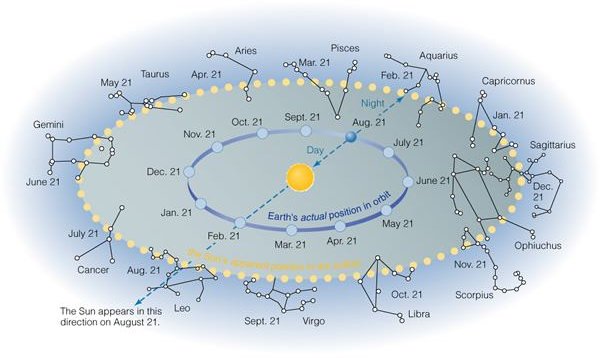
All that we have discussed so far comes under astronomy i.e. tracking the positions of different celestial objects using handy models. Astrology takes it a step further and divides the ecliptic into special regions. The movement of the Sun, Moon and planets through these regions is said to have different implications for our personal lives. Both Western and Indian astrology do this differently.
Western astrology divides the ecliptic into 12 equal segments starting from the Vernal equinox. Since the ecliptic is a circular strip of sky spanning 360 degrees, this division creates zones of 30 degrees each. Each zone is named after a prominent constellation found in that zone as shown in the figure above. These zones are usually called the tropical zodiac or just the Zodiac.
Indian astrology also divides the ecliptic into 12 equal segments (30 degrees each) starting from a point which lies diametrically opposite to a star named Spica (also called Chitra in Sanskrit) on the ecliptic. This point is currently around 24 degrees east of the Vernal equinox. These 12 segments are called Rashis or sidereal zodiac. The sky is also separately divided into 27 equal segments (13 deg 20 arcmins each; 1 deg = 60 arcmins) called Nakshatras, each of which has a certain star or star cluster associated with it. Each Nakshatra is further divided into 4 equal zones called Padas (3 deg 20 arcmins each).
The Role of the Solar System
Now the division of the celestial sphere is not the whole story. The major planets in the Solar System i.e. Mercury to Neptune orbit the Sun in more or less the same plane. Therefore when viewed from Earth, they also seem to move very close to the ecliptic. Astrology works by noting the position of these planets with respect to the ecliptic divisions during the time of a person’s birth. This information is recorded in the person’s horoscope and it is believed that these alignments influence us on a personal level.
The relative importance of each solar system object depends on the school of astrology. For example in Western astrology, the position of the Sun with respect to the Zodiac is given prime importance. The position of the Moon and other planets come later. However in Indian astrology it is the position of the Moon with respect to the Rashis and Nakshatras that matters most followed by the Sun and other planets.
Indian astrology also considers the position of two special points on the Moon’s orbit in a horoscope. Recall that although the planets move close to the ecliptic, there is always some offset. The Moon has this offset too and there are only two points where it is exactly on the ecliptic. These are known as Rahu and Ketu.
At the end of the day, both systems are built on the foundational idea that celestial alignments during the time of birth are closely intertwined with human lives. We shall see that based on our current understanding of astronomy/astrophysics, along with the results of many controlled experiments, it is safe to say that there is very little evidence to support the validity of any astrological belief.
Are Astrological Ideas Theoretically Sound?
The idea that planetary alignments have an influence on human life at first thought does seem plausible. After all, we do feel the gravitational effects of the Moon through the tides of the ocean and that of solar radiation which creates the beautiful Aurorae Borealis (northern lights) and Aurorae Australis (southern lights) on the poles. So is it far fetched to assume that maybe the planets effect our lives, even on a personal level? Let us see if this is possible based on our understanding and astronomy/astrophysics.
Arbitrary Divisions
One of the theoretical issues with astrology, is the arbitrary way in which the sky is divided. Divisions of the ecliptic like Zodiac, Rashis, and Nakshatras are essentially human-drawn labels imposed on the celestial sphere. These divisions might help astronomers organize the sky and track planetary movements, but they don’t correspond to any natural or physical boundaries in space. Despite this, astrologers often treat them as if they hold real cosmic significance.
Take for example the idea of “ruling planets,” where each zone of the sky is said to be governed by a particular planet that supposedly exerts a special influence while in that zone. For instance Mars is said to be the ruling planet of the Aries zodiac in Western astrology and of the Mesha Rashi in Indian astrology. But there’s no physical reason why Mars being at 0° Aries should suddenly start having a unique effect compared to when it’s at 29° Pisces. Just like time does not physically change when you cross human defined time zone boundaries on a map, the ecliptic zones in astrology are completely artificial and have no physical basis in nature. In fact, there are an infinite number of ways one could divide the ecliptic, all equally arbitrary.
This becomes even more obvious when you realize that different schools of astrology divide the sky differently. Western astrology starts the zodiac at the Vernal equinox, while Indian astrology begins diametrically opposite to the star Chitra (Spica). These systems carve up the same sky in different ways, yet each claims to reveal universal truths about human life. Furthermore there is a slow wobble in Earth’s rotation (called axial precession) that causes the position of the equinoxes to drift over time. This means the tropical and sidereal zodiacs have been drifting apart by about one degree every 72 years, and are now roughly 24 degrees out of sync. Despite this divergence, both systems claim accuracy and predictive power, even though they assign different predictions to the same person born at the same time.
If astrology were truly grounded in some objective truth, we’d expect a single, globally agreed-upon method to define these divisions, which is based on some objective aspect of the cosmos. Not multiple, conflicting ones with subjective definitions. The fact that such variation exists strongly suggests that astrology is built more on cultural tradition and superstition than on physical reality.
The Fundamental Forces
Another major theoretical hurdle comes from considering how a planet, could potentially influence human lives. According to modern physics, all interactions between objects are governed by one or more of the four fundamental forces of nature:
- Gravity
- Electromagnetism
- Strong Nuclear Force
- Weak Nuclear Force
The first two of these are pretty common to our everyday experience. Gravity is what causes all objects with mass to attract each other. It is what holds your feet firmly to the ground and what holds the planets in orbit around the Sun. Electromagnetism on the other hand acts on anything with a net charge or with a net magnetic moment. It is what powers the electricity in our homes, sticks magnets to our fridge and is also how light itself is transmitted.
We also have the strong and weak nuclear forces which are virtually absent in our everyday lives but are dominant at the scale of individual atoms. We know that atoms are made of a nucleus which is surrounded by electrons. The nucleus itself is made up of smaller particles called protons (positively charged) and neutrons (not charged). Since protons are all positively charged, they tend to repel strongly (like charges repel). However it is the strong nuclear force that opposes this repulsions and keeps the atomic nucleus intact. The weak nuclear force is also prevalent at these scales and is what drives radioactivity in some elements (like Uranium, Plutonium etc.)

Any interaction between two physical objects in the universe can ultimately be explained by one or more of the four fundamental forces. For example, the high and low tides on Earth are caused by the gravitational pull of the Moon. The Northern and Southern Lights (auroras) occur when charged particles from the Sun, carried by the solar wind, interact (via electromagnetic forces) with Earth’s magnetic field. This field channels the particles toward the poles, where they collide with molecules in the upper atmosphere, creating the beautiful glowing patterns we see in the sky. The broader point is: when celestial objects influence Earth in any way, we can trace those effects back to the well-understood fundamental forces.
Coming back to astrology, this means that if suppose the planets did have some sort of influence on our daily lives then this influence can only be mediated through the fundamental forces. So let us consider each one and check whether any particular force can act as a suitable candidate. Now some proponents of astrology might already insist that the effect the planets have on us is mystical or supernatural and is thus beyond the four fundamental forces known to us. We shall consider this position as well, after we have looked at the fundamental forces.
The Nuclear Forces
Lets start off with the strong and weak nuclear force. Can the planets have any effect on human lives via this force? The short answer is no. The reason for this being that both the nuclear forces do not have a very long range. More specifically these forces only act on particles that are separated by less than one quadrillionth of a meter (10-15 m and 10-18 m for the strong and weak nuclear force respectively; for those unfamiliar with scientific notation 10-15 means 0.00…1 with 14 zeros between the decimal and 1).
If the particles are separated farther than that, the nuclear forces have virtually no effect. Now it is common knowledge that the planets are extremely far away from us. Even the Moon, which is the closest celestial object from us is 384,400 kilometers away. This is around a trillion trillion times farther than the range of the nuclear forces. So we can immediately rule out these forces as candidates for mediating astrological effects.
Gravity
The next obvious choice is gravity and this is where things get interesting because unlike the nuclear forces, gravity can act at extremely large distances. This is how the Sun is able to gravitationally influence very faraway objects like Pluto which is 5.9 billion kilometers away. So is it not possible that the planets are somehow influencing our daily lives through gravitational effects?
Plain Gravity
The problem with this reasoning is that although gravity has a long range, it is incredibly weak! Think about it this way: if you lift your device on which you are reading this, you are overcoming the force of gravity exerted by the entire Earth on the device. Now imagine how miniscule the gravitational effects of other planets would be in our daily lives.
There is actually a way to quantify this using Newton’s Law of Gravitation which states that the force of gravity (denoted by F) between two objects with masses m1 and m2 separated by a distance r is given by the equation:
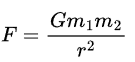
Here, G is known as the gravitational constant which equals 6.67 x 10⁻¹¹ m3 kg-1 s-2. It can be seen that gravity falls of as the inverse square of the distance. This means if two objects are separated by twice their original distance, the gravity between them will reduce by four times. Also the ridiculously small value of G is what makes gravity so weak. So what is the gravitational force of the planets on us?
Let us take the largest planet Jupiter with a mass of 1.9 x 1027 kg (that is 1.900… with the decimal followed by a 9 and 26 zeroes!!). On an average, Jupiter is 800 billion meters away from Earth. Now consider a newborn baby who weighs around 3 kg. The gravitational influence of Jupiter on this baby can be calculated by just plugging in these numbers into the equation above. What we find is that the baby will experience only 6 x 10⁻⁷ N!! This is 10 million times weaker than Earth’s gravitational pull on the baby. You can try this exercise with any planet using its mass and distance values from the internet.
And the real kicker comes when you consider what happens when we calculate the gravitational pull on the baby exerted by the doctor who made the delivery. Let us assume this doctor is 80 kg in weight and holds the baby about 20 centimeters (0.2 meters) at arm’s length. If we again plug in the numbers, the force exerted by the doctor comes to be around 4 x 10⁻⁷ N!! This is on the same order of magnitude as the force exerted by Jupiter. What this implies is that if we are to assume that astrological influences of planets are mediated by gravity then we must also include effects of the doctor who delivered the baby. Not only that, we must also consider the gravitational influence of the baby’s mother, its father and every person in the operating room who decides to hold the baby. No astrologer takes any of this into consideration.
Tidal Forces
But what of the Moon or the Sun? Surely if they can influence tides on Earth via their gravity, they can very possibly influence human lives that way? I actually once had a conversation with an acquaintance who asked: “The Moon seems to have so much influence on the Earth’s oceans. Now our body is 70% water so don’t you think the Moon must be having some divine astrological influence on us too?”
The answer is still no. The tidal forces are the result of the fact that the Moon’s gravity (and to a smaller extent the Sun’s) on the side of the Earth closer to the Moon is greater than on the opposite side. This causes the Earth to stretch because the side of the Earth close to the Moon is pulled harder. The larger this size difference, the greater the tides. The tides have nothing to do with water. The Moon also experiences tidal forces due to Earth but because it is solid, we do not visually observe its effects.
Now the tidal force of the Moon will not effect a newborn baby because the size of the baby is extremely small compared to the Moon. The Moon’s gravity on its head will be almost identical to that on its feet or arms. Hence there will be almost zero tidal effects on the baby or any human for that matter.

Due to its extremely weak strength we can rule out gravitational influence of planets on humans to have any astrological effect on our lives.
Electromagnetism
Our last choice is electromagnetism and this is even more interesting because not only is this force long ranged like gravity, it is also way stronger. In the simple case of two stationary particles with unit mass (1 kg) and unit charge (1 coulomb) separated by 1 meter, the electric force experienced by the two particles is close to a billion trillion times (1020 times) stronger than the gravitational force experienced by the particles. So surely this is how planets influence our lives astrologically?
Electric Effects
Not so fast. While gravity is weak, electromagnetism introduces a different problem: the existence of both positive and negative charges. Unlike mass, which is always positive and therefore always attracts, electric charge can cancel out. An object with equal amounts of positive and negative charge has net zero charge, meaning it neither exerts nor experiences a noticeable electric force. What is the net charge of the planets? You guessed it: its zero. Even our bodies contain minimal net charge so it is impossible for us to feel any significant electric force. If this was not the case you would be receiving electric shocks as you read this article.
Magnetic Effects
You might now wonder about magnetic fields, especially with the Sun and Jupiter having gigantic ones. Again this does not work because the magnetic fields only act on objects with a net magnetic moment. Our bodies contain very little magnetic moment for magnetic fields of distant planets to have any effect. Furthermore, planets like Mercury, Mars, Venus and even our Moon do not possess magnetic fields and are yet very much considered in astrology. As an aside, a bar magnet would have more magnetic influence on you than even the Earth’s own magnetic field! We don’t see any astrologer containing the positions of all bar magnets during our birth do we?
Electromagnetic Radiation
Finally what about, electromagnetic (EM) radiation, such as light, X-rays, UV rays, or radio waves which are waves of both electric and magnetic fields? As far as the Moon and planets go, the only significant EM radiation we receive from them is the visible light (reflected sunlight) we use to admire their beauty! Sure that does have an influence on us in the sense that it instills a sense of awe of the cosmos. But not much else.
Now some planets like Jupiter emit weak radio signals or infrared radiation, but by the time this energy reaches Earth, it’s so faint that it’s practically undetectable without specialized instruments. The Sun is the only object whose EM radiation has a significant effect on us. It gives us warmth, powers the climate, and yes, can give you a sunburn if you’re not careful. But even the Sun, with all its radiation, doesn’t micromanage your love life or your career path.
Hence it is impossible for the planets to have any significant influence on our daily lives through any means allowed by theoretical physics. This directly challenges the fundamental premise of astrology and raises serious questions about astrological claims.
An unknown mystical or supernatural force?
Now a very common objection to all this would be to assert that maybe the astrological effects of the planets has nothing to do with the four fundamental forces. Maybe its some mysterious fifth force or a mystical effect that modern science is yet to discover. Surely just because we have not discovered such a thing does not disprove the possibility right? I even see some podcasts on the internet claiming that “modern science has not advanced enough to understand astrology.”
That is a bad argument because it pushes us deep into the realm of pure speculation. If one is allowed to speculate then actually anything is “possible”. For instance it is possible that invisible unicorns rule the Earth and decide our destiny. Maybe the Moon is inhabited by goblins who decide our IQ levels. The point is that arguing for something based on speculative guesses removes all grounds for reasoning. Just because modern science does not agree with a particular idea does not mean it eventually will. The possibility of yet unknown evidence is not evidence in itself.
Our current understanding of physics shows no evidence of any fundamental force beyond the four mentioned earlier. There has been some speculation of a fifth force but nothing is confirmed yet and even among the speculations there is nothing to suggest that it has anything to do with astrology.
More Points to Ponder
Beyond the points already discussed, our current understanding of astronomy and astrophysics presents several additional challenges to the possibility of astrology being true. To keep this article concise, I’ll briefly outline them below.
What Astrology Ignores
Astrology traditionally includes only the Sun, Moon, and planets up to Saturn: objects visible to the naked eye in ancient times. However, the Solar System also contains Uranus, Neptune, several dwarf planets (like Pluto, Eris, Ceres, Sedna, Haumea etc.), moons larger than Mercury (like Ganymede, Callisto of Jupiter and Titan of Saturn), and millions of asteroids and comets, all of which are ignored in astrological calculations. This selective inclusion strongly suggests astrology originated from superstition based on what was easily visible to the naked eye rather than comprehensive celestial knowledge.
Now modern Western astrology has started incorporating the positions of Uranus, Neptune and Pluto in their predictions but this is only after they were discovered in 1781, 1846 and 1930 respectively. We will have more to say on this in the very next section. However the point still stands that even after including these three objects, Western astrology still ignores a vast majority of the Solar System.


Predictive Powers of Astrophysics vs Astrology
Here is an interesting thought. In 1781, after Uranus was discovered by William Herschel, astronomers started using Newton’s laws of gravity to calculate its predicted future positions. However when they took actual measurements of its position, they noticed there was some error as compared to their predictions. French mathematician Urbain Le Verrier hypothesized that there might be an unknown planet tugging at Uranus and using Newton’s laws he predicted where he expected the planet to be. When astronomers looked at this region of the sky in 1846, they found Neptune. This case demonstrates the predictive powers of astrophysical theories and their contribution to new discoveries.
Now suppose Uranus, Neptune and all the other Solar System objects mentioned above did have some astrological effect on us like Western astrology now claims. Then ancient astrologers would have noticed errors in their predictions since they did not consider these objects. This would have immediately prompted search for these missing planets in the sky. However it was the astronomer who discovered Neptune and not the astrologer. So either:
- Either planets like Neptune have no astrological influence, despite being massive bodies in the solar system. This raises big questions on why only certain planets have astrological significance.
- Or, much more likely, astrological predictions are based on outdated, pre-scientific beliefs that don’t adjust in response to new discoveries.
Fortunately, even if one were to ignore all these theoretical obstacles and insist on pure speculation to argue for astrology, it is very easy to test the claim. Remember that predictions form a big part of astrology and therefore it can be easily verified. So has anyone tested whether astrology works? It turns out some researchers have and their findings are what we shall move on to next.
Empirical Tests of Astrology
There have been several controlled experiments that have been conducted to verify whether astrological predictions work. Since we are dealing primarily with Western and Indian astrology in this article, we will discuss two major studies that have been conducted to test either belief. These are:
- Of Western astrology: A study performed by Dr. Shawn Carlson in 1985 titled “A double blind test of astrology” which was published in the journal Nature, one of the world’s most prestigious academic journals.
- Of Indian astrology: A study performed by Dr. Jayant Narlikar in 2009 titled “A statistical test of astrology” published in Current Science, a scientific journal managed by the Indian Academy of Sciences.
Spoiler Alert!: Both these experiment conclusively showed that the claims of astrology that were being tested, did not hold weight. However in addition to this there is an additional study which claims the opposite: that astrological correlations do exist. This is:
- The Mars Effect: A study by French psychologist Michel Gauquelin in the 1950s colloquially know as “The Mars Effect” which claimed to show a correlation between athletic capability and the position of Mars at birth.
We shall look at each study and see what it implies for astrology.

The Carlson Experiment
In 1985, a physicist named Dr. Shawn Carlson performed what is now known as one of the most famous tests of Western astrology. His experiment involved 28 esteemed astrologers who were nominated by the National Council of Geocosmic Research (NCGR), an organization dedicated to promoting research in astrology in the US. Their claim was that it was possible to determine the personality of an individual given their horoscope (also called a natal chart). To avoid vagueness around the term “personality” the astrologers recognized the California Psychological Inventory (CPI) as a well reliable source to generate the personality test of given individuals.
And all the experiment aimed to do was to test whether Western astrology worked as it claimed. Carlson used the horoscopes of 100 random individuals along with their CPI results and asked the astrologers to correctly match the horoscopes to the corresponding CPI personality. To avoid fairness and remove any bias, Carlson was not shown the correct answers until after the experiment and the astrologers did not know the identity of the individual behind each horoscope. What did he find?
It was observed that the astrologer’s could not correctly match the CPI personality to their corresponding horoscopes. It was also noted that the performance of the astrologer’s was equivalent to a scenario where the CPI profiles and horoscopes were matched randomly. Hence it was concluded that Western astrology, as it is practiced currently, does not align with how the universe actually works. The findings of the study were published in the journal Nature in 1985 (linked above) and has been recognized as one of the most influential studies on testing the validity of Western astrology.
The Narlikar Study
Although Carlson’s experiment mostly involved astrologers practicing Western astrology, a similar study has been done to test the validity of Indian astrology. In 2009, Prof. Jayant Narlikar, who was an emeritus professor at the Inter University Center for Astronomy and Astrophysics (IUCAA) in Pune, conducted what could be called the Indian equivalent of the Carlson experiment. Prof. Narlikar who unfortunately passed away a few days before the time of writing (20 May 2025) was a world renowned astrophysicist and cosmologist and also the founding director of the IUCAA.
Similar to Carlson, Narlikar set up an experiment where he invited 51 Indian astrologers (out of which 27 ended up sending their predictions) and representatives of an organized Indian astrology institution to participate. Due to privacy concerns, the details of the participants have not been made public. The astrologers claimed that given a person’s horoscope they would be able to accurately determine their mental capacity. To test this Narlikar collected the horoscopes of 200 children, 100 of which were deemed intellectually gifted and 100 of which were diagnosed with an intellectual disability. The astrologers were asked to classify children into either category based on their horoscope.
What made the experiment particularly noteworthy was that the astrologers were tested on objective, binary predictions (intellectually gifted or not) and not vague or subjective concepts like ‘personality’ that are open to interpretation. So how did they fare? Well you guessed it, their predictions actually ended up performing worse than chance. That is the astrologers would have had a better accuracy of predictions if they had randomly classified the children into the two categories. This study demonstrated that the principles of Indian astrology did not work as claimed and the results were published in the Current Science journal managed by the Indian Academy of Sciences.
Gauquelin’s Mars Effect: A Positive Case For Astrology?
Now all this is not to say that there have been no claims of experimental validation of astrology. One of the most cited studies as a positive case for astrology is what is dubbed as “The Mars Effect” experiment conducted by French psychologist Michel Gauquelin way back in the 1950s. For his study Gauquelin collected the horoscopes of thousands of athletes and found that a significant number of them were born when Mars was at two specific points: either rising at the horizon, or at the highest point (zenith) in the sky. This finding was used to suggest that the position of Mars might have an influence on the athletic skills of a person. Sounds a lot like astrology! But there is a problem: several attempts to replicate this experiment have failed.
Two independent studies were conducted by American (in 1975) and French (in 1994) researchers. The American group consisted of the statistician Prof. Marvin Zelen in close association with the Committee for the Scientific Investigation of Claims of the Paranormal (CSICOP). The French group consisted of Committee for the Study of Paranormal Phenomena (CFEPP). Both of these groups collected horoscope data from a completely new group of American and French athletes respectively. However they could not find any evidence of the Mars effect in their data and their results are available here (CSICOP) & here (CFEPP).
The failure to replicate Gauquelin’s results has led many to question the initial results as a statistical fluke rather than a positive case for astrology. Australian scientist and former astrologer Geoffrey Dean also noticed that the Mars effect was not observed in athletes born after 1950. He suggested this might be due to more accurate birth records in later years, since prior to 1950, many birth times were reported by parents from memory rather than by doctors at the moment of birth.
Further Tests of Astrology
Although the above mentioned studies remain the most well known tests of astrology, they are far from the only ones. Other noteworthy mentions include:
- Geoffrey Dean and psychologist Ivan Kelly conducted a large scale scientific test of astrology consisting of 40 studies involving 700 astrologers and 1000 horoscopes. All the studies showed that astrologers performed no better than chance.
- Dr. Nagesh Rajopadhye (former Indian astrologer, ISRO scientist and IT professional) has conducted further tests of Indian astrology all of which demonstrated no evidence for its validity.
- Quantitative sociologist David Voas examined the horoscopes of 20 million people using census data from England to see if it corresponded to their marriage success. It did not.
Now a common way one could dismiss all this is to say “maybe the astrologers studied by these researchers are not real astrologers. They might not know the correct way of making predictions.” While this is a possibility, such a statement only begs the question of what a “real” astrologer is. The experiments mentioned above have surveyed practicing astrologers from recognized astrology organizations. If one could always dismiss any study critical of astrology by making such statements then this would render it impossible to test astrology.
I have even heard people on the internet say, “The astrologers you see in newspaper columns are conmen and the real, enlightened astrologers seclude themselves from civilization. That is why you never hear about them.” Although an interesting thought, that would be like me saying that I have the ability to fly and shoot lasers from my eyes but choose not to do so when people are looking. Any claim that cannot be tested runs deep into the realm of speculation and hence cannot be taken seriously.
The Forer Effect: Why Astrologers Sound Accurate
If you’ve made it this far, you might be thinking, “But my astrologer actually seems to describe me quite accurately!”. You’re not alone in feeling that way and there’s a well-known psychological explanation for it. It’s called the Forer Effect (also known as the Barnum Effect). This phenomenon describes how people tend to accept broad, vague statements as deeply personal and uniquely applicable to themselves, even though the same statements could easily apply to almost anyone.
For instance, imagine your astrologer says something like, “You’re going through a period of stress and uncertainty,” or “You often find yourself losing patience over certain things.” These statements might feel surprisingly accurate, until you realize they could apply to almost anyone. Most people experience stress or anxiety at some point, and everyone has specific triggers that test their patience. When we hear a vague statement like this, our brains automatically search for personal examples that make it feel true. This creates a powerful illusion of accuracy.
This psychological tendency was first studied by American psychologist Bertram Forer in 1948. In his now-famous experiment, he gave 39 students personality readings and asked them to rate on a scale of 0 (worst) to 5 (best) how accurate they felt the readings were. The average ratings given by students was 4.3 which meant almost all of them considered their readings to be accurate. Now here is the kicker: they all got the same personality reading copied from an astrology column! This clearly demonstrated how the human mind could be persuaded to accept vague statements by astrologers as some divine revelation about themselves.
In conclusion, based on our understanding of astronomy/astrophysics and results of numerous experiments it is safe to state that astrology is a superstitious belief system. Its principles are rooted in arbitrary divisions of the sky, are based on outdated solar system models, are in direct contradiction to theoretical physics and have no empirical support. The heavens may inspire us but attributing our personalities, decisions, or destinies to the positions of celestial objects, but this remains a reflection of human imagination more than cosmic truth.
By understanding the science behind the stars through astronomy and astrophysics, we can appreciate the universe for what it truly is: vast, awe-inspiring, and governed by laws far more fascinating than any horoscope.
 The Void Above